
Enhancing Home Safety with Motion Sensor Lights
Feel safer at home with a reliable outdoor lighting system. Motion sensor lighting not only deter unwanted guests but also increases potential detection. While many homes already have existing outdoor lighting, it’s essential to make sure it is maintained and fit for purpose. Security lighting doesn’t have to be unsightly or dull, integrating landscape lighting with sensors can welcome you home and serve to deter would be burglars.
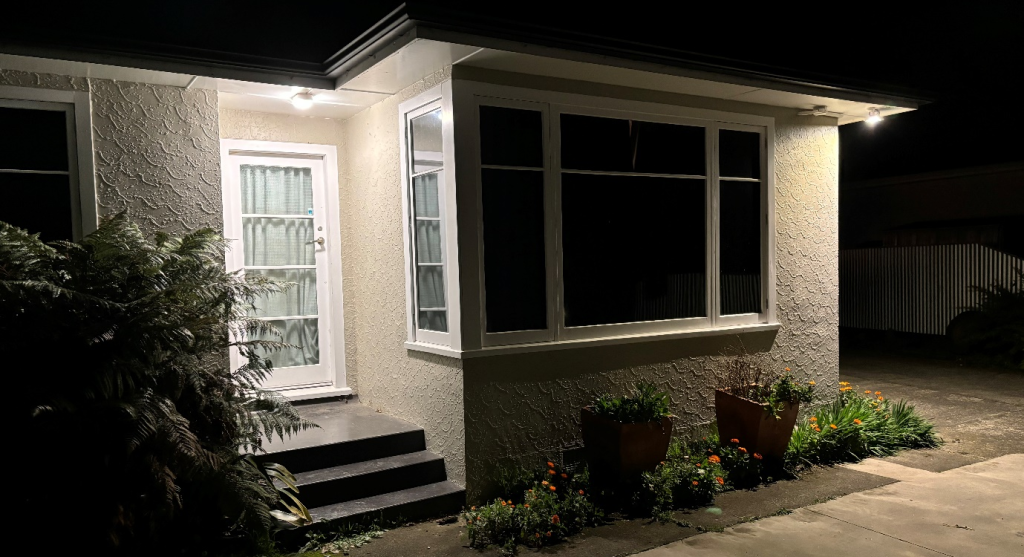
Motion Sensors:
Motion sensors are available both as part of the light and separate from, both have their advantages. There are also two typical sensor types and an often overlooks extra functionality.
- Built-in motion sensors: Lights with built in motion sensors are one of the most common types of outdoor motion sensor lights. You probably have an image of that twin-spot light on the end of your garage. While these are becoming more aesthetically pleasing, they’re still limited in looks and functionality.
- Separate motion sensors: Independent motion sensors open up a world of aesthetics and function. With stand alone motion sensors you can choose from a great range of lights and can control multiple lights off one sensor, widening the area illuminated.
- PIR: Passive Infrared (PIR) motion detection is the most common form of motion detection used in outdoor lighting. PIR sensors are triggered by a change of ‘heat’ traveling through ‘zones’ in the sensors lens.
- Microwave These detectors emit microwave signals and measure the time it takes for the signal to reflect back to the sensor. This duration, known as the echo time, helps calculate distances to stationary objects within the detection zone. When a person enters the zone, their movement disrupts the microwave beam, altering the echo time and triggering the lights.
- Manual-Override A commonly overlooked function that is available on many quality sensors and sensor lights. This allows you to override the ‘time-out’ of the sensor so you don’t have to stand there waving your arms to re-activate the sensor during that long goodbye when your guests leave.
Positioning
- Light Placement: Positioning security lights strategically is crucial. Aim to illuminate high-traffic areas like the front door, driveway, and entranceway, as well as less visible spots such as the backyard and side paths. Multiple smaller lights are more effective than just a few floodlights as they give a more uniform spread of light. Finding the right vertical placement matters—too low invites tampering, while too high reduces effective illumination. Utilize existing features to keep lights out of reach while maximizing coverage by pointing them at the ground.
- Weather exposure: A big consideration should the placement of the sensor so that weather doesn’t shorten the life of the sensor. Most sensors have a low outdoor rating (IP44) so are best kept out of the rain. UV can also damage the lens, with New Zealand’s UV being as harsh as it is, this will make the sensor become less effective.
- Sensor range: Most sensors have an 8-10 meter detection range. It’s good to understand the range that you are working with, installing a sensor that is more sensitive than required will allow you to adjust the sensor over time as the sensor ages potentially extending functionality of the sensor.
- Sensor direction: Because of PIR sensors lens design, they are more sensitive to an object crossing their path or moving on a diagonal rather than straight onto the sensor. Consider angling the sensor so that main approach for your property are diagonal to the sensor.
- Security cameras: Motion sensor light placement should be consider in conjunction with security cameras, as motion sensor lights can create glare on security cameras cause the camera to be rendered ineffective. Motion sensor lights can also delay security cameras switching from day to night mode which can result in an interrupted image.
Consider Your Neighbours
While motion sensor lights are effective, consider all your neighbours when installing them, even the littlest ones. Bright lights constantly illuminating neighbouring windows can be irritating, running all night they can have a negative impact to the environment. Opt for well-directed lighting that enhances security without causing inconvenience to others.
Get in touch with Roundhouse Electrical, and let’s work together to provide you with a personalised electrical solution for your home!